Funding Creative Textile and Upcycling Community Projects: Lessons from Past SG Eco Grant Awardees
In This Article
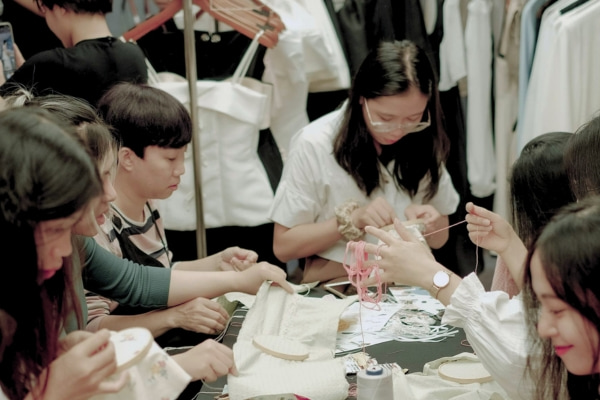
At an Active Ageing Centre in Tampines, a group of aunties gather around sewing machines and discarded banners, cutting them out to sew them into carrier bags. The finished bags go on to serve different “missions” – sold to raise funds, displayed at exhibitions to raise awareness of environmental issues, returned to the companies that donated the banners, or given free to AAC members.
This ground-up project is organised by Lions Befrienders and backed by the SG Eco Fund – a $50 million fund by Singapore’s Ministry of Sustainability and the Environment to support community projects that advance environmental sustainability locally.
It is one of four we’ll walk you through. These projects are featured in the SG Eco Fund’s Annual Report 2024. They show what the fund has enabled when creative minds, the community and a desire to tackle textile waste come together.
Banner Upcycling, by Lions Befrienders Service Association (LBSA)
LBSA is a social service agency providing eldercare support at select Active Ageing Centres in Singapore. Before the project, their sewing group had already been using their needlework skills for a cause – sewing bags, purses, and other handicrafts out of donated fabric to raise funds.
The Banner Upcycling project bridged the social mission with an environmental cause. The grant allowed them to scale up, buying more sewing machines to open their workshops to the wider public. These hands-on sessions did not just teach sewing, they turned a familiar daily waste item – discarded banners – into awareness of local waste issues, and showed how the community could take actions to tackle them.
The results: Over the course of the project, 130+ banners were upcycled and 590 people engaged. And if you are thinking they were all aunties, you are mistaken. Uncles joined in and enjoyed making their own tote bags to “save the earth” too.
The takeaway: Seniors aren’t uninterested in environmental issues. They just don’t often have a platform to engage with them. Integrate sustainability into activities they already love, enthusiasm follows and awareness spreads with it.
Sew Can I, by Image Mission
Image Mission is a non-profit helping women from disadvantaged backgrounds gain economic independence through interview preparation, image coaching, and career support. Since 2015, the organisation has supported over 1,400 women, through their Dress for Success® and I M Ready programmes.
The Sew Can I project taught the women to turn used clothing into practical items like bags and household accessories. With funding from the SG Eco Fund, their workshops gained scale and spread awareness to an online community where participants could showcase their creations, swap ideas, and champion mindful textile consumption together.
The results: Over a year, 500 kg of textile waste was diverted and around 90 women learnt fabric upcycling skills. The response was so strong that founder Pang Li Kin later said she wished she’d applied for a bigger grant to accommodate more participants.
The takeaway: “Don’t limit your project’s potential by the funding quantum,” advises Pang Li Kin.
Singapore Eco Arts Festival, by Tan Wee Leng and Natalia Tan
Natalia Tan is a textile artist with an impressive commercial track record, featured in Vogue and Female, and having worked with brands like Dior, Diptyque, and Samsonite. An advocate of sustainability and socially-engaged artmaking, she turned to the SG Eco Fund to bring to life the idea of weaving artworks from salvaged waste based on participants’ personal interpretation.
Together with Tan Wee Leng, she co-founded the Singapore Eco Arts Festival to bring the practice to the community. The festival included workshops led by experienced artists, an exhibition at library@orchard showcasing both the participants’ pieces and sustainability-themed works by other creative practitioners, and outreach to Singapore’s sustainability community.
The results: Over one year, more than 1,800 people were engaged and 350 kg of textiles, plastics, and glass upcycled into art. Participants also gained a new appreciation for art in everyday objects, and many found the experience therapeutic.
The takeaway: The Eco Art Festival co-founders encourage future applicants to work closely with the SG Eco Fund team. The process helped them refine and articulate the project’s mission and impact objectives. The funding team isn’t just assessing your application, they’re a resource for making it stronger.
Vintagewknd Trashion Week, by That WKND Company
That WKND Company is the outfit behind Vintagewknd, a popular homegrown vintage and reworked clothing brand in Singapore. Before the project, they were already creating content on preloved and upcycled fashion and building a following that cared about where their clothes came from.
Trashion Week came into being from a collaboration with Stridy – a community-led cleanup movement in Singapore that tracks litter data through its app. Built around the theme of “picking up trash while wearing trash”, the project used the novelty of fashion made from waste to turn litter-picking into an engaging public event.
For four weeks, participants cleaned up trash dressed in upcycled fashion that matched the theme of the location, e.g, beach-inspired outfits for beach cleanups. The activities were filmed and shared on social media to spread the message on tackling waste and sustainable consumption.
The results: Over four weeks, more than 100 people showed up in person to collect 65 kg of trash from Singapore’s public spaces. The content generated over 1.2 million impressions on social media.
The takeaway: Co-founder Eden Tay echoed Natalia Tan in his message to future funding applicants: attend the workshop on how to apply effectively and work closely with the SG Eco Fund team.
How to Make Your Sustainability Idea Happen with SG Eco Fund
The awarded projects and what their leaders shared afterwards show how funding criteria get applied in practice. Here are five considerations as you plan your project and submit your funding application.
Structure the project for sustained environmental impact
In all the projects above, community participants walked away with the knowledge and skills needed to carry on the action on their own or within their groups. They may pick up upcycling as a hobby, teach a friend how to do it, or start looking twice at things they’d have thrown out.
A useful question to ask is: “what environment-friendly action stays in the community after the project ends?” A successful project doesn’t end when the funded window closes.
Set clear, measurable outcomes
The evaluation committee emphasises measurability of results in both community engagement and environmental impact. Think in terms of:
- Kilograms of waste diverted, garments reused, materials kept out of landfill
- Number of participants in events
- Number of impressions, views, and interactions of digital content on online platforms
These are benchmarks the funding committee needs to assess your project’s impact, and goals for you to work toward when the grant is approved.
Expand your impact through partnerships
Maybe you are an upcycling artist who can work up creative designs, or a community member who can teach others how to sew, or someone with an audience that needs environmental education. Individually, it’s hard to pull off an environmental project that reaches the community. But partner up, and it becomes possible.
Match the budget to the impact
The fund is looking for budgets that are commensurate with impact. Do due diligence on each budget item. But don’t undersell the ask. If the idea has the potential to reach more people, go for its potential impact, not the funding category limit.
Leverage the SG Eco Fund team’s support and resources
Past applicants have noted that the funding team helps sharpen the project itself, and recommended attending the workshop on how to apply effectively. It can be useful for you too.
On a Circular Fashion Journey Yourself?
Wherever you are in the world, get in touch to share your ideas, progress, or hurdles.
We’d love to hear your story, or put our heads together to solve your current challenges with you.
Keep Reading

The Short, Medium, and Long Loops of Circular Fashion
A clear guide to circular fashion in Singapore, what it means, how it differs from sustainability and ESG, and the three pathways to start the…
8 Hands-On Upcycling Workshop Ideas for Diverse Groups
Explore 8 engaging upcycling ideas community events or corporate sustainability days that show textile waste actions everyone can take.
Sakala-si and Sakiori: How Designers Elevate Upcycled Textiles on the Global Runway
How runway fashion labels upcycle without limiting design freedom: A case study for brands rethinking upcycling and circularity