The Short, Medium, and Long Loops of Circular Fashion
In This Article
27 Clothing Items a Year
Sometime in the past year, you probably did what most of us did: bought a piece of clothing, wore it a handful of times, let it sit in the wardrobe for a while, then decided it needed to go to make room for newer clothes.
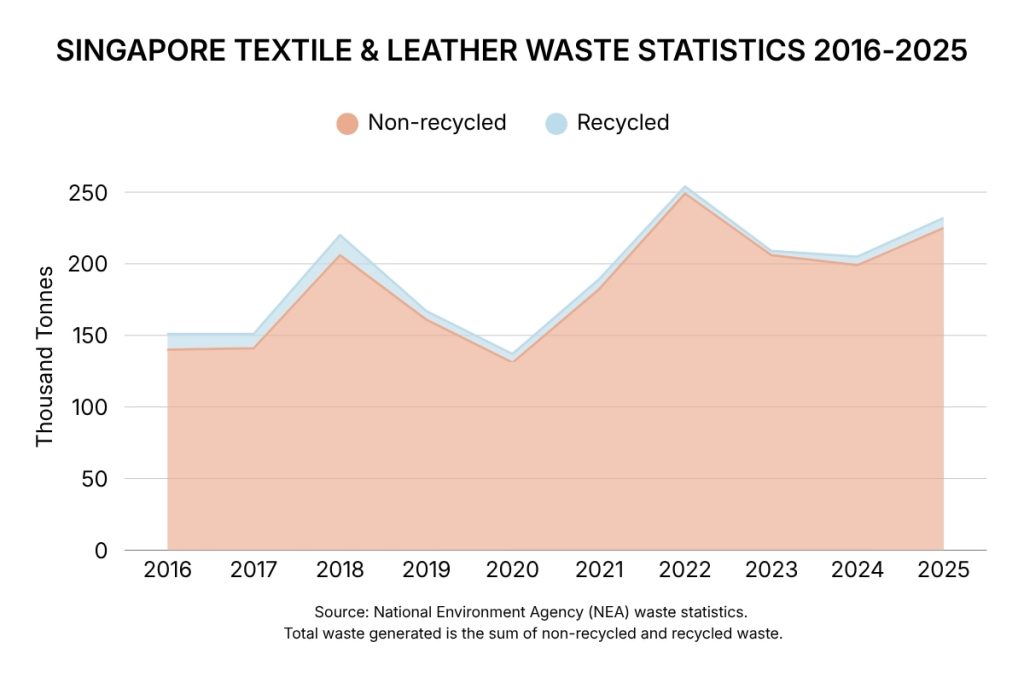
You are not alone. A survey of 1,000 Singaporeans found that on average, we buy 34 new clothing items a year, and dispose of 27. Multiply that by a few million wardrobes, add in what businesses discard, and it’s no surprise the island generates over 200,000 tonnes of textile waste a year. Up to 98% of it ends up incinerated and landfilled.
The mounting textile waste is only the visible part of fashion’s environmental impact. What we hardly see are the massive resources that go into the making of our clothes. For example, a single pair of jeans, before reaching consumers in Singapore, uses up between 3,000 and 4,000 litres of water during its production. Across the industry, fashion is responsible for up to 10% of global carbon emissions – more than international flights and maritime shipping combined.
We all have a hand in fashion’s alarming environmental footprint, with the 27 items each of us lets go of every year. And that also means we all have a hand in making a difference.
But the change process needs to start long before a garment is binned, with how it is made, what material is used, how we care for it and give it more lives before it has to be disposed of.
From Linear to Circular Fashion
The concept of circular economy (CE) isn’t new, though it is relatively new to fashion. Back in the 1960s and 70s, economists started voicing concerns about the prevalent ‘take-make-dispose’ model of production and consumption. It is unsustainable because it treats raw materials for production as disposable and infinite, when they are not. Without interventions, the system guarantees depletion of natural resources and irreversible environmental damage.
The term ‘circular economy’ conceptualises how a sustainable system works. Coined in 1989 by British economists David Pearce and Kerry Turner, it describes a closed loop system that maximises product and material usage by keeping them in continuous use, through designing for reuse, repair, remaking, and recycling. In contrast with the linear approach of take-make-waste, the circular approach is regenerative, resilient and sustainable, because unneeded materials from one production cycle continuously become the resources for the next.
The idea moved from economics into mainstream policy through the 2010s, as governments and industries reckoned with decades spent running in a straight line. Fashion caught up too.
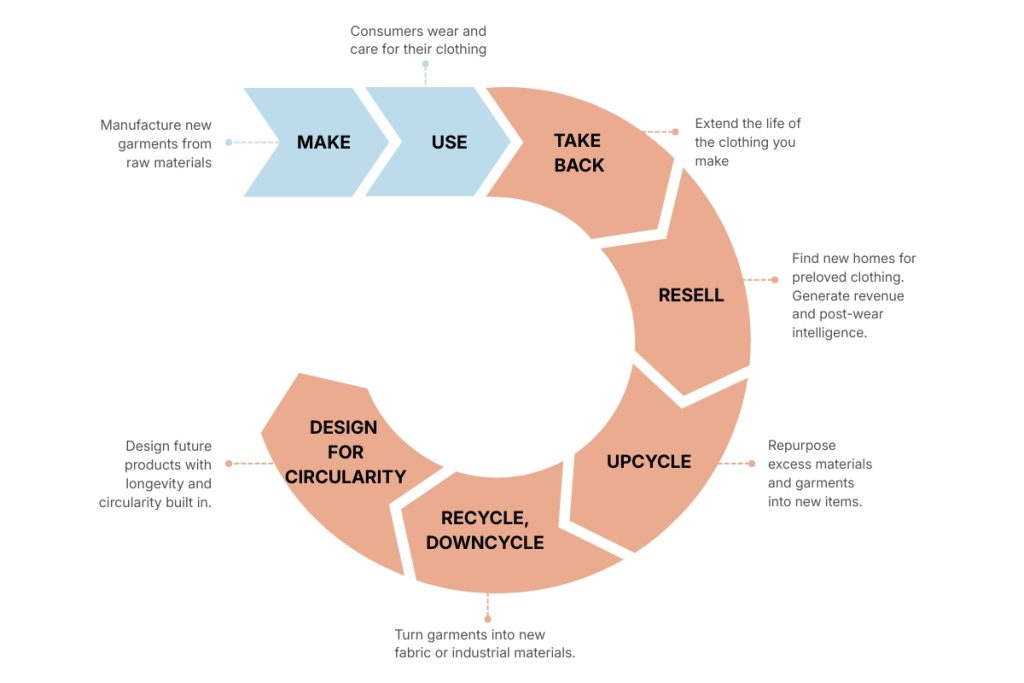
In 2014, Swedish sustainability consultant Anna Brismar came up with the term ‘circular fashion’, applying the same logic to clothing. The linear approach to fashion – its harmful impact compounded by ultra-short product cycles – urgently needs to be replaced by a circular model to mitigate the industry’s devastating toll on the planet and human lives.
The Three Loops of Circular Fashion
The circular economy isn’t just one circle repeating itself. It is made up of multiple loops of different lengths, serving different objectives, all working together to keep products and materials in use for as long as possible.
In the classic illustration of circular economy by the Ellen MacArthur Foundation – known as the “butterfly diagram”, smaller, inner loops are preferred over larger, outer loops. This is because inner loops retain more of a product’s embedded material, labour, energy and other values. For instance, repairing a broken jacket zipper keeps the jacket at its highest value, whereas recycling reduces the cut and sewn pieces of fabric to raw materials. Recycling is the outermost loop, and the last resort employed when the inner loops aren’t applicable.
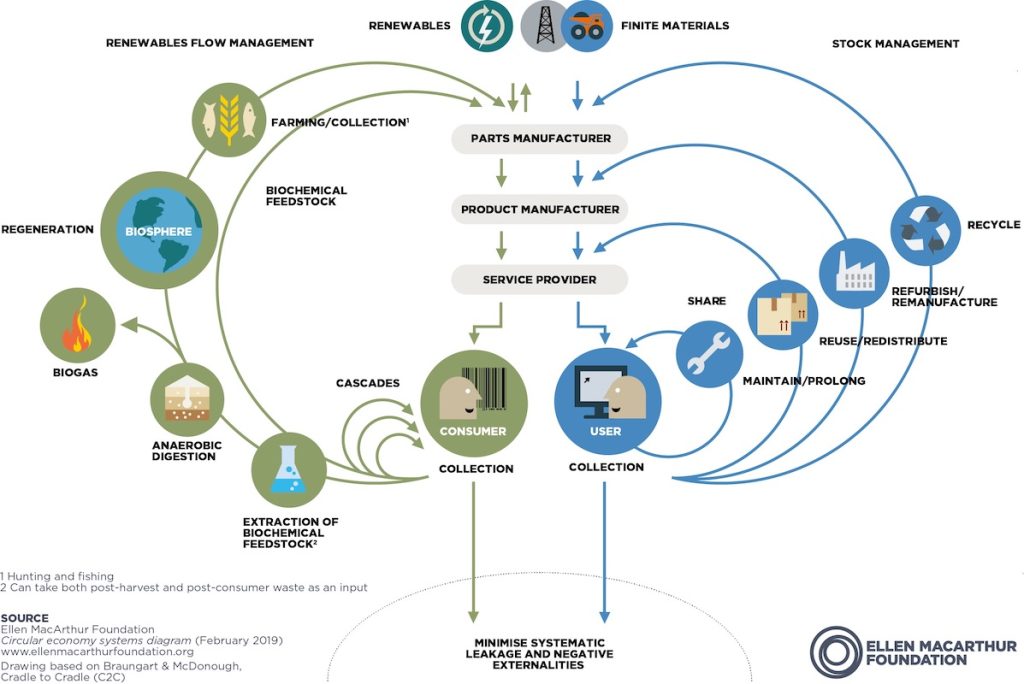
In our circular fashion research, our team at Lucerna evaluated the viability of the different loops in the Singapore context, drawing on the butterfly framework by the Ellen MacArthur Foundation and the R-hierarchy of circular economy value retention options (Potting et al., 2017; Reike, Vermeulen & Witjes, 2018). These findings are synthesised into three distinct types of loops in circular fashion, categorised by what is required to make each happen:
- The Short Loop – Resell, Rewear, Repair. Requires wearable clothing and someone who wants it. The apparel circulating in this loop keeps its form, function, and nearly all of its value. A big part of the short loop is known as fashion recommerce – a segment projected to grow two to three times faster than the first-hand fashion market between 2025 and 2027, according to the BoF-McKinsey State of Fashion 2026 report.
- The Medium Loop – Upcycle, Repurpose. Requires skill, tools, and time. One or more pieces of clothing are transformed into a new textile item. The outcomes vary in value and purposes, ranging from runway designer pieces to daily DIY household items, depending on the transformation process.
- The Long Loop – Recycle, Recover. Requires industrial machinery and fabric recycling technology. Recycling breaks down garments and textile products into raw fibres, to be spun into new yarns and woven into new fabrics again. However, as of this research, textile recycling technology still faces significant hurdles in doing what it is designed to do.
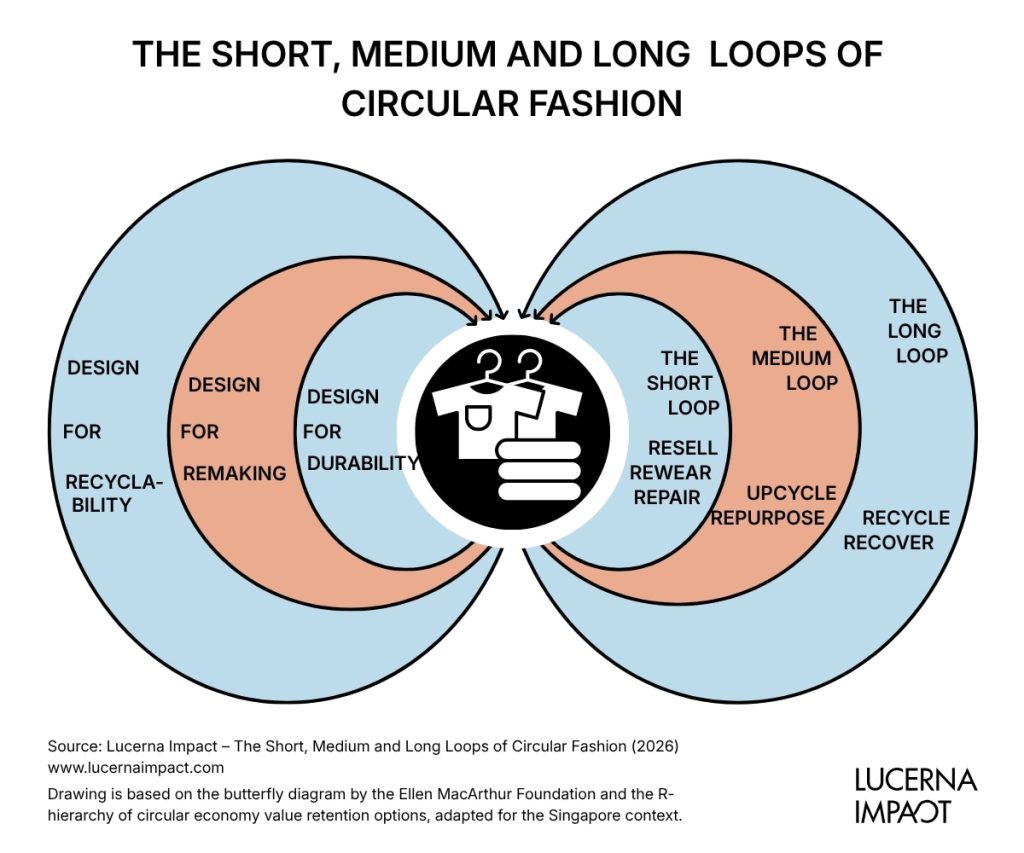
The three loops on the right side only happen if the design process on the left side has the intended loops in mind. This involves:
- Design for Durability. These are multiple considerations to keep clothing in the short loop. Examples include generous seams for alteration and repair, quality fabric that lasts, and style that can be worn for more than one season.
- Design for Remaking. Old denims, 100% cotton t-shirts and flannel sweaters are favoured by upcyclers for a reason. They hold shape, provide more room for manoeuvring, making upcycling easier. Clothes best fitted for the medium loop are typically cut from large, uninterrupted panels in solid colours or all-over patterns, and assembled with stitching rather than bonding or fusing, so the garment can be taken apart and refashion into something new.
- Design for Recyclability. At the current state of recycling technology, single-fibre materials have the highest chance of being recycled, though not all of them can be. To be a circular fashion brand, sourcing and design need to take into account what will happen at the end of life of a garment when they enter the long loop.
Together, these practices enable clothing to be easily recirculated and have multiple lives after it leaves the studio.
What Does Circular Fashion Mean for a Brand in Practice? And How Is It Different from Sustainability and ESG?
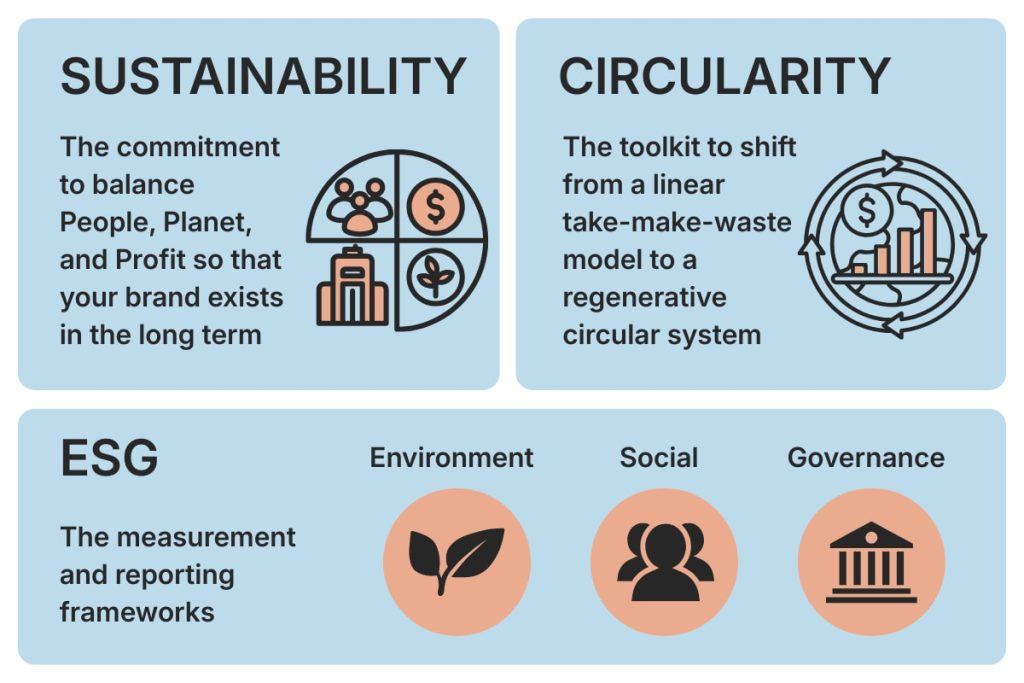
The three terms – Sustainability, Circularity, and ESG – are often used interchangeably in casual conversation, but they serve distinct functions in a brand’s business strategy: one is the goal, one is the toolkit, and one is the measurement.
- Sustainability is the broadest umbrella term. It is the commitment you make to ensure your brand exists in the long term. For a fashion brand, it is part of the brand ethos, the “why” behind the promise that your business will not grow at the expense of its environment or people.
- Circularity is the toolkit to achieve sustainability. It helps you systematically answer the how and what questions without falling into the greenwashing trap. The three-loop diagram lays out which pathways are open to you and what it takes to close them. In the rest of this article, we’ll help you prioritise which loop to close first.
- ESG is the measurement. ESG frameworks provide a structured way to measure and report a company’s performance in environmental, social, and governance criteria to key stakeholders, typically investors, regulators and customers. It highlights non-financial metrics that matter most to a business, such as the amount of textile waste diverted from landfills, the fair wages paid to contracted workers, and the governance structure you have in place to prevent supply chain abuses.
How Does Zero Waste Design Fit in with Design for Circularity?
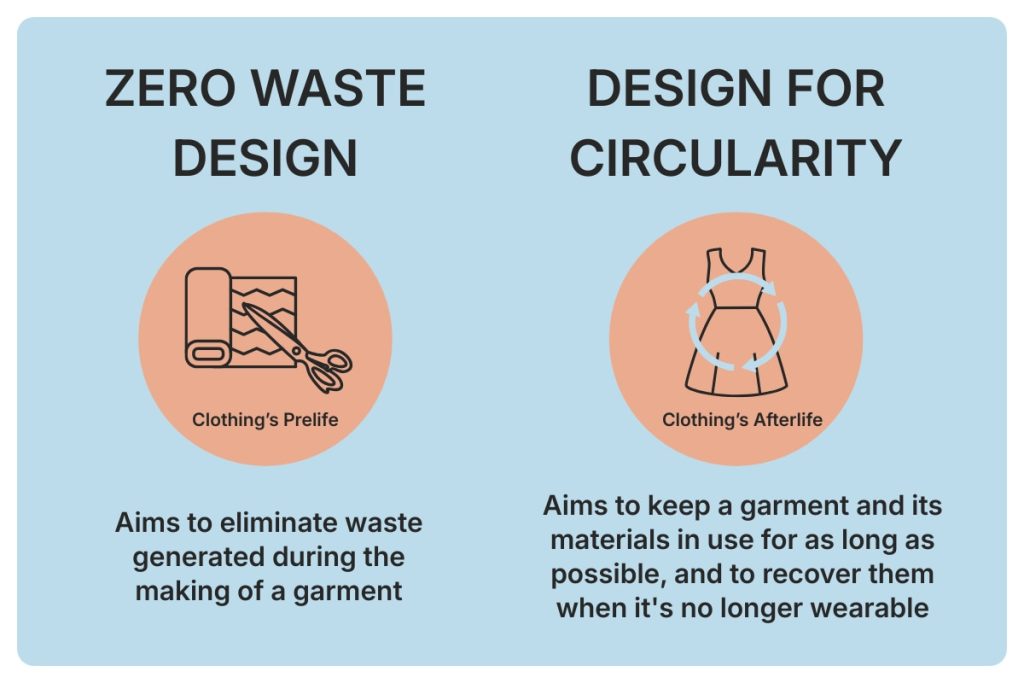
Zero waste design and design for circularity are both design principles in service of sustainability, but they deal with different kinds of waste.
- Zero waste fashion design aims to eliminate waste generated during the making of a garment, known as pre-consumer waste. It covers practices such as zero waste pattern cutting, turning offcuts into small goods, and digital pattern-making and sampling to reduce error and off-spec production.
- Design for circularity addresses what happens when a finished garment is still wearable but discarded, and subsequently when it is no longer wearable. This is known as post-consumer waste. It is the more pressing issue in the fashion industry today, given the volume of clothing disposed of and how little of it is recovered.
The designer has a decisive role here, because whether a wearable garment can have a second life is determined by sourcing and design decisions. That is where the three principles on the left of the loop diagram – design for durability, remaking and recyclability – come in. Together, they enable a garment and the material in it to have more lives through the short, medium and long loops.
The two design principles are complementary. Neither replaces the other.
In practice, far fewer brands publicise design for circularity than zero waste design. Between March and June 2026, our team reviewed the websites of 73 homegrown fashion brands in Singapore that publicly position themselves on sustainability. Eighteen stated zero waste design practices. Two mentioned take-back of any kind.
This is understandable. Zero waste design is practised inside the studio, where a brand controls the process. Take-back and resale require reverse logistics, sorting, grading, a resale channel and relationships with various partners in the medium and long loops to process unsellable clothing.
Design for circularity needs to start in the design room, but the operation to make it happen sits well outside it. That is why we built our branded take-back programme, so brands can get their ‘source of truth’ to design for circularity while we run the operations that close the loop.
Which of the Three Loops of Circular Fashion Should Be Prioritised?
Start with the short loop – rewear, repair, resale. The shorter the loop, the more value is retained. For a fashion brand, this means offering quality products and a take-back programme for customers who no longer want them, then repairing and reselling wearable items. If resources allow, explore the medium loop – upcycling items that can’t be resold. The long loop – recycling – is the last resort, for products too damaged to be repaired or upcycled.
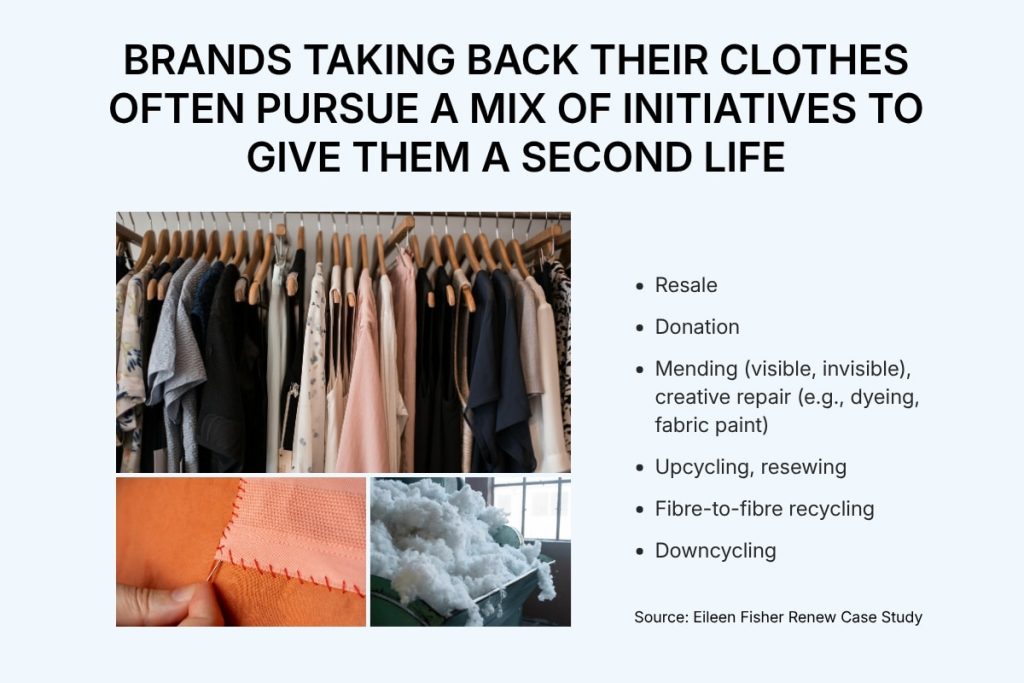
That said, value retention is not the only consideration. Which loop to close first also depends on your available resources, design direction, and what your brand stands for. There is no single solution in circular fashion. Even brands that have been on the circular path for years, like Eileen Fisher, run a mix of initiatives. It’s the combination that adds up to meaningful impact.
Interested in implementing circular fashion loops?
Drop us a line and we will be glad to assist you!
Isn’t Recommending Resale First Just Accepting the Status Quo Instead of Driving Innovation?
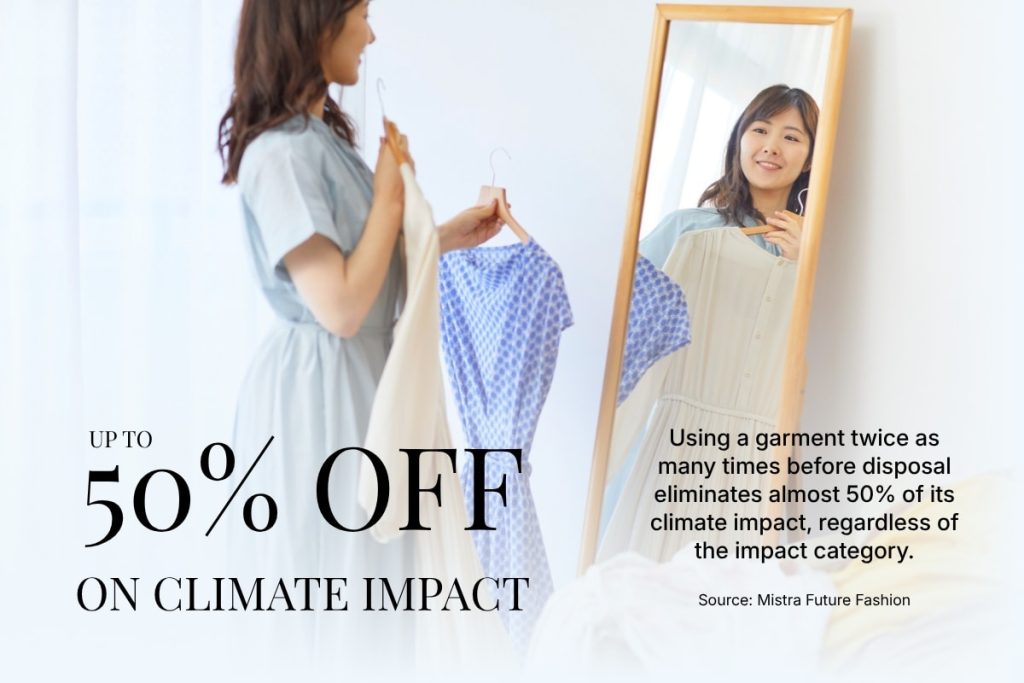
Resale isn’t recommended first because it is the least disruptive to the status quo, but because it is the most impactful and accessible pathway available to fashion brands today. Research by Mistra Future Fashion found that using a garment twice as many times before disposal eliminates almost half of its climate impact, across every impact category. The maths is straightforward: a large part of a garment’s environmental footprint is created during production, so every additional wear brings down its impact per wear.
Resale also retains the most of a product’s embedded value, compared to other circular activities. This makes it the loop most likely to generate financial returns for the brand. A sustainability effort can only be ‘sustained’ in the long-term when it creates a net benefit rather than net cost to the business. Pioneering brands have shown this is possible.
In the young field of circular fashion, all the loops work together and innovation is happening in every step. Resale requires innovation in reverse logistics. Upcycling demands a new way to make use of discarded material. Recycling at scale requires breakthroughs in fibre technology, as does new material development. Being on the circular path already means you are rejecting the status quo of take-make-waste, and innovating your business for a better future.
Can Upcycling Actually Make a Dent in Singapore’s Textile Waste?
The short answer is no. Upcycling will not absorb Singapore’s textile waste by the tonne. It is a craft, and craft doesn’t scale the way machinery does. What it scales is something else: awareness of textile waste, empowerment of individual action, appreciation for the intangible value that goes into making a textile item, and potentially, a positive shift in someone’s relationship with waste.
For consumers, upcycling is an experience and an education. For fashion brands, it can be a creative muse or a practical challenge, depending on the situation. If you run a take-back programme and have items too damaged or dated to resell, the medium loop – upcycling, creative repair, and refashioning – recovers more value from them than sending them to the recycler or the incinerator.
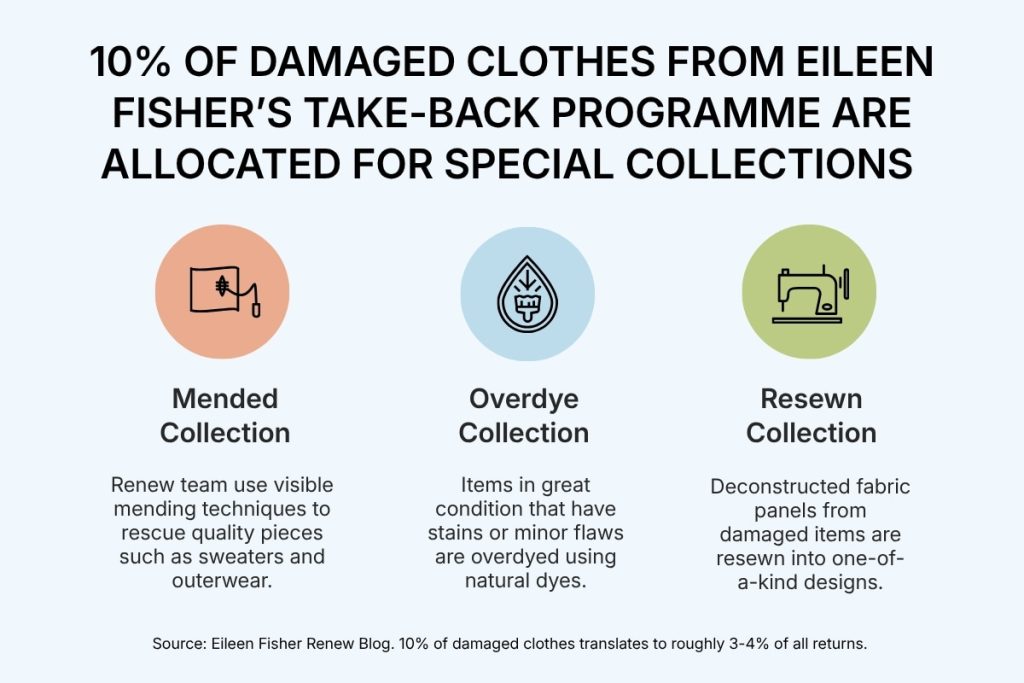
Upcycling is also an effective way to tell your brand’s unique story or design philosophy to your audience. In Singapore, upcycling artists, refashioners, and fashion brands are encouraged to use their creativity to engage the public in environmental causes.
And in that process, you may find inspiration for your next collection or even create something for the runway. See how award-winning designers have done it.
Is Recycling the ‘Real’ Long-Term Solution? Why Is It Not Happening Yet?
Recycling may one day become a large part of the answer to textile waste, but it is not there yet. And even if it could handle waste efficiently, recycling alone would not be the answer to sustainability. A garment is much more than fibre, its environmental footprint is not reset when it is recycled back into fibre. Recycling is meant to recover the raw material, but the energy, water and labour embedded in spinning, dyeing, cutting and sewing are lost, and must be spent all over again to create a new clothing item.
Among the three loops, recycling is the longest loop, with the least value retention. However, it is a necessary last resort in the Singapore context. With only one landfill on Pulau Semakau, projected to run out of space by 2035, recycling is a solution for processing textile waste in bulk and at speed.
So why don’t we see more textile recycling? Because recycling a garment is a fundamentally harder problem than recycling a plastic bottle or a cardboard box. Modern apparel is made of a multitude of fibres, blends, dyes and finishes. Separating these into clean recyclable streams is one of the industry’s hardest unsolved problems. A 95% cotton, 5% elastane top, for example, is unrecyclable with current commercial technology. The elastane acts as a contaminant, compromising the purity of the cotton stream.
For mono-fibre fabrics, recycling technology exists, but the facilities are too far away from Singapore for recycling to make commercial sense. The nation is actively working towards local recycling capability. In August 2022, Nanyang Technological University and Royal Golden Eagle – the world’s largest viscose producer – joined hands to launch the S$6 million research centre RGE-NTU SusTex. Its goal is to tackle the bottlenecks described above: separating mixed fibres – with a focus on cellulose-based fabrics, automating the sorting of textile waste, removing dyes without harsh chemicals, and developing new recyclable textiles.
Until recycling is commercially viable in or near Singapore, the long loop cannot be fully closed yet. But the short and medium loops are already within our reach.
Can Waste-to-Energy Be an Effective Solution to Textile Waste?
If we were to place Waste-to-Energy (WtE) on the three-loop diagram, it would be a fourth, outermost path. The reason it is not part of the diagram is that it is not circular in nature: materials that enter WtE have very limited further use at the end of the process, if any.
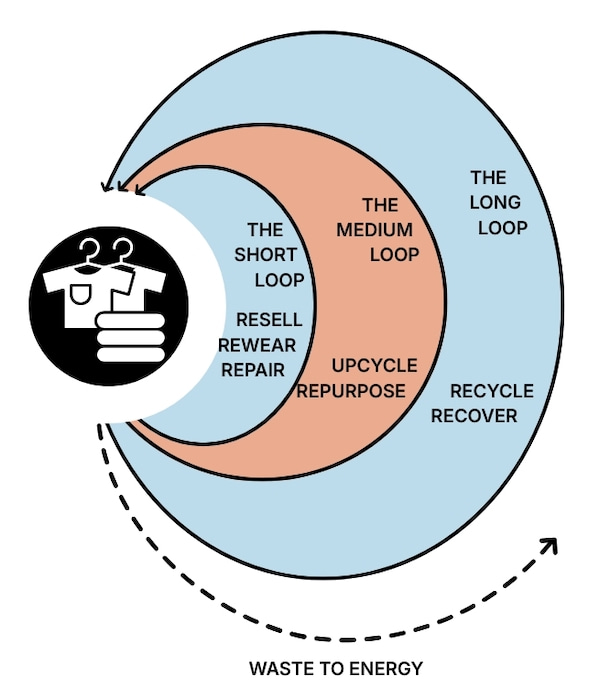
Notice from the illustration that the WtE path is not a loop. It is a linear process in which waste is converted to energy and ash. In Singapore, some of the ash is processed into “NEWSand” and trialled in road construction – a demonstration of how hard the country is working to stretch what remains. Wider use of the ash is still being studied. For now, the majority is landfilled.
From a waste processing perspective, WtE is efficient at reducing waste volume and generating energy. Singapore’s four operating WtE plants generate enough energy to meet 2% of the country’s electricity needs. WtE is also the reason Semakau Landfill has lasted as long as it has: waste entering a WtE plant comes out as ash at roughly 10% of its original volume.
However, from a circular economy perspective, WtE recovers energy once and destroys the material for good. It does not solve the resource depletion problem of the take-make-waste economy. For fashion to become circular, the loops need to close, and WtE is not a closed loop.
Can Donation Be a Loop? Why Do Some Charities and NGOs in Singapore Start to Refuse Used Clothing?
Donation of clothing is part of the short loop when it works as intended, i.e., when it achieves one of these two objectives:
- Direct distribution: a donated item finds a beneficiary who needs it.
- Fundraising: a donated item finds a customer who pays for it, and the proceeds fund the charity’s work.
In Singapore, fundraising is the more common route. Direct distribution requires matching items to individuals’ needs, which makes it labour-intensive and hard to scale.
The Salvation Army’s Re:Nue thrift stores, the Singapore Council of Women’s Organisations’ New2U thrift shop, and the Society of St Vincent de Paul’s SSVP Shop are some of the well-established examples of the charity shops. The proceeds go towards causes such as providing shelter and supporting vulnerable groups, including survivors of domestic abuse, at-risk youth, and ex-offenders.
But selling donated goods for fundraising has its own challenges. As far back as 2018, a CNA report found that The Salvation Army could put only 8 to 10 per cent of donated clothes on its store shelves. The rest exceeded what stores could absorb and had to be exported in bulk. But the export outlet is narrowing, as countries grapple with their own textile waste and tighten import regulations. This is why some charities and NGOs maintain strict rules on what donated clothing they accept, or decline it altogether. Without the capacity to sort, sell, or redistribute what they receive, unsellable items become a cost to the very organisations trying to raise funds.
For the public in Singapore, donating to charities with thriving thrift stores contributes to the short loop. When doing so, follow each charity’s donation requirements and donate only what it can sell. For fashion brands, donation works as part of the short loop only when the brand is directly involved in selling or matching items to needs. Without that involvement, a cash donation is often more useful to the beneficiaries.
Interested in implementing circular fashion loops?
Drop us a line and we will be glad to assist you!
If Textile Waste Is Such a Problem, Why Isn’t It a National Priority Waste Stream?
This question is best answered by officials at the Ministry of Sustainability and the Environment (MSE). What we can do here is lay out the published facts that shed light on it.
Our primary source is Singapore’s Zero Waste Masterplan published in 2019 – the national blueprint for building a circular, resource-resilient economy. It identified three priority waste streams: food, e-waste, and packaging, selected on the basis of generation volumes, recycling rates, and environmental impact.
In 2018 – the year preceding the Masterplan, Singapore generated 763,000 tonnes of food waste. Packaging waste, including plastic, paper, metal, and glass, made up a third of all domestic waste. These were the two streams with the highest volumes. E-waste makes up less than 1% of Singapore’s waste, but it is prioritised due to the environmental hazard it poses when not properly managed.
Textile waste stood at 220,000 tonnes that same year, well below food and packaging in volume. And unlike e-waste, discarded clothing poses no acute environmental hazard.
Textile waste is also a more complex problem to address. With fibre-to-fibre recycling technology still at an early stage, textile waste will continue to be largely non-recyclable. This means that Waste-to-Energy (WtE) – though not a circular solution – remains the most feasible short-term measure for processing textile waste in bulk. However, it comes at a cost. Apart of the loss of value and material, the resulting ash from WtE adds pressure to Semakau Landfill, and works against the national target of cutting 30% waste sent to landfill per person per day by 2030.
The long loop cannot close yet, but the short and medium loops are where individuals and brands can act. And MSE actively supports these ground-up environmental initiatives through the SG Eco Fund. The S$50 million fund, launched in November 2020, has funded a number of community projects tackling textile waste – from workshops teaching simple upcycling skills to creative fashion made from discarded clothing that raises public awareness of waste.
Priority can also come from the ground up, advancing the short and medium loops that are already feasible.
On a Circular Fashion Journey Yourself?
Wherever you are in the world, get in touch to share your ideas, progress, or hurdles.
We’d love to hear your story, or put our heads together to solve your current challenges with you.
Keep Reading

8 Hands-On Upcycling Workshop Ideas for Diverse Groups
Explore 8 engaging upcycling ideas community events or corporate sustainability days that show textile waste actions everyone can take.
Sakala-si and Sakiori: How Designers Elevate Upcycled Textiles on the Global Runway
How runway fashion labels upcycle without limiting design freedom: A case study for brands rethinking upcycling and circularity
Funding Creative Textile and Upcycling Community Projects: Lessons from Past SG Eco Grant Awardees
Learn how Singapore’s fashion brands, textile artists and social agencies are using the SG Eco Fund to scale upcycling workshops and community initiatives.