Eileen Fisher’s Renew Programme: a Working Blueprint for Circular Fashion
In This Article
Three Million Items
In June 2026, Eileen Fisher’s take-back programme – Renew – crossed a significant milestone: three million items returned.
Since 2013, customers have sent their preloved clothes back to the brand, receiving a $5 gift card per piece. The brand has logged and inspected every item, and found a new life for them. Along the way, these preloved pieces have reshaped how Eileen Fisher designs, sources, and thinks about its own products.
From a Charity Project to $1.8M in Net Financial Benefit from Take-back
The first seed of Renew was planted in 2009, when employees brought in their own worn clothes to resell for charity. It wasn’t formalised into a public take-back programme until 4 years later, when Eileen Fisher launched it to customers nationwide in the US. A simple marketing campaign was run with the tagline “We’d like our clothes back, thank you very much.”
The goal was zero waste, but the brand wasn’t heavy on sustainability messaging. Circular fashion wasn’t a thing back then. They simply wanted to make sure their clothes ended up in the right place, though they didn’t know exactly how yet.
Customers, as it turned out, wanted the same thing. A deluge poured in, from as far as Hawaii, sent by customers who spent more on shipping than they got from the gift card token. Customers included personal notes with the clothes, which the Renew team saved and fondly called “love letters,” recounting what the item meant to them – a daughter’s wedding, a first job interview, or just because they couldn’t bear to see it in the garbage.
The customer response was heartwarming. But finding new life for preloved items took the team’s grit and innovation. The brand was candid about the challenges they faced in the early days. “We didn’t wave a magic wand to do this,” says Lilah Horwitz, Director of Renew Content & Marketing, on the Renew blog. “It is a really hard thing that the brand did.” But they went all in, figuring out sorting, mending, even cleaning along the way. All employees used to take a day sorting and a day doing laundry each week, no matter what their job was.
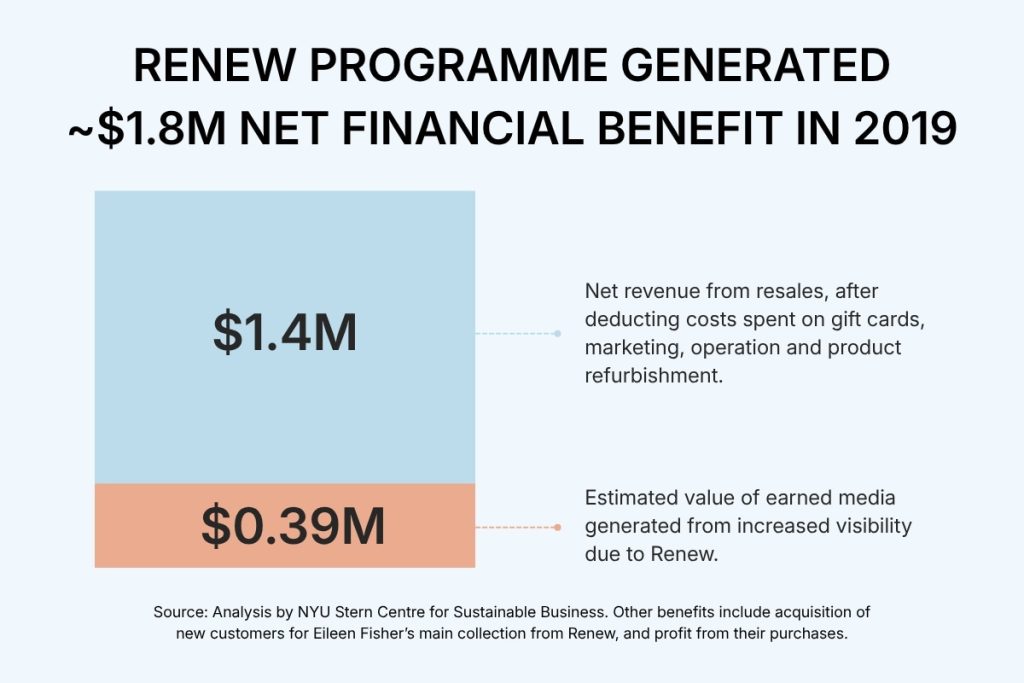
The vision took shape, and the trial and error paid off, in customer loyalty, earned media, and profit. In 2019, the NYU Stern Center for Sustainable Business calculated that Renew generated $1.8 million in net financial benefit for the brand in that year alone.
In 2022, the CNMI Sustainable Fashion Awards honoured Eileen Fisher with the well-deserved “Pioneer Award” for the brand’s contribution to redefining the fashion industry’s approach to sustainability and circularity.
Today, fashion brands embarking on circularity look to Eileen Fisher for inspiration, insight, and a working blueprint.
“I would love to leave behind a model for a more holistic, circular and regenerative kind of clothing company.”

Coming Full Circle: From a Take-back Programme to a Design System
More than just bringing in secondary revenue, Renew is a valuable “source of truth” for design decisions.
In searching for recycling options for damaged items that can’t be rehomed or repurposed, the team realised that synthetics and blends, including nylon, spandex, polyester, and even viscose, are practically impossible to recycle through today’s commercial recyclers. A garment can begin its life with the best intentions – made from a dominantly sustainable mix of 97% organic cotton and 3% elastane for comfort. But that added elasticity makes its next life impossible with current technology.
Within recyclable single-fibre materials, a lack of infrastructure and scale results in high costs, making it infeasible to recycle certain types of fabric. For example, fibre-to-fibre recyclers will easily take in 100% cotton or natural wool garments, but they won’t take silk. This feedback loop forced a shift toward mono-materials that are recyclable from the get-go for the design and sourcing departments at Eileen Fisher.
The returned items also reveal physical wear patterns that help improve designs. The sorting team may notice the same split down the side seam of a specific line of pants, or a certain fabric developing a specific type of stain with wear. That information goes back to the design room, iterating on the next collection. The best way to design for durability is to know how durable the garment is in the real world.
Over the years, the fabric team at Eileen Fisher has continued to research and develop recycled yarns that are functionally comparable to the virgin materials consumers are used to. The Fall 2024 Collection marked an important milestone. The brand introduced a circular sweater made from 80% recycled wool collected through the take-back programme. As of this writing, it is still on shelves, and customers still love it.
Today, 75% of Eileen Fisher’s products are made with lower-impact or certified materials with durability and recyclability in mind – a direct result of what the take-back data taught them about how their clothes wear, age, and return.
Once you know how your clothing is coming back, you can design forward.
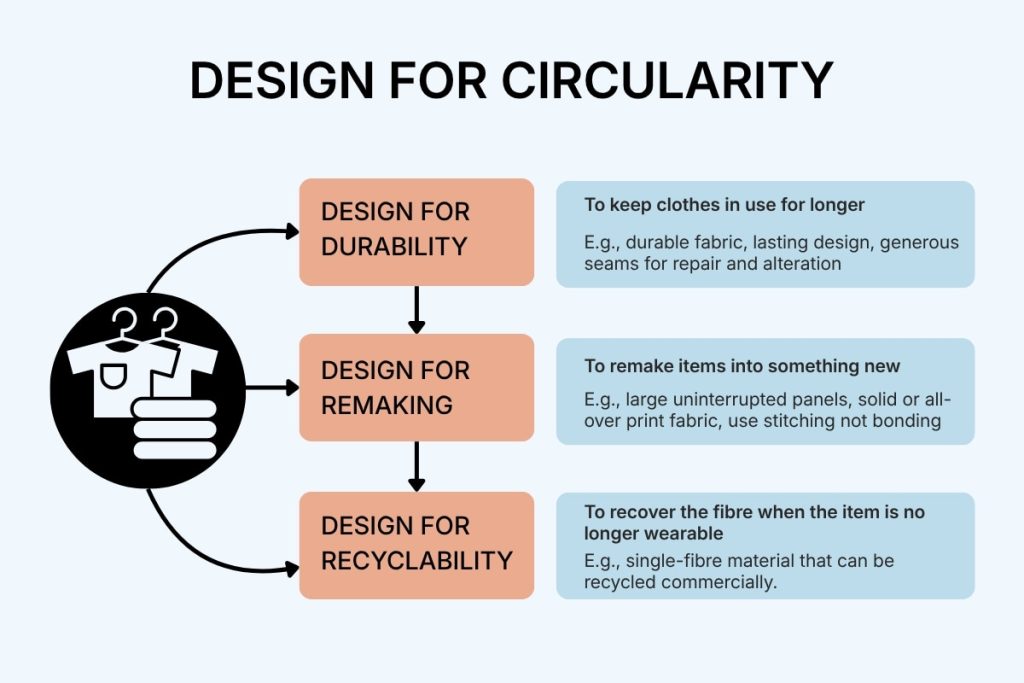
Together, these design principles keep clothing and material in circulation through the short, medium and long loops of circular fashion. Learn more about the three loops and how to integrate them into your design practice here.
Four Lessons from Renew for Fashion Brands Considering Take-back
1. Take-back deepens the bond with your customers, and attracts new ones
When you invite your customers to participate in your circularity effort, take-back becomes more than a logistics process. It builds a shared sense of purpose.
Renew’s Director of Content and Marketing – Lilah Horwitz – attributes the programme’s success to the fact that it is an example of a brand living by its values and inviting customers into a positive, impactful cycle. “They get to be a part of our community and the company’s circular vision,” she explains.
The other “byproduct” is new customer acquisition. Industry analysts note that Renew has successfully opened the brand to younger customers increasingly increasingly drawn to slow fashion, offering them an accessible, values-driven entry point. Internally, staff at Eileen Fisher have observed a significant share of Renew customers who had never purchased from the main line before.
Renew doesn’t just give new life to clothing, it gives the brand a renewed customer base.
2. Circularity requires a product worth circulating
Some of the best, most durable pieces that Eileen Fisher’s customers return are the vintage items the founder designed herself in the early days. Why? Because they were made with high-quality, pure natural fibres and simple construction. Realising this has only deepened the brand’s long-standing commitment to quality.
High quality is also what forms the bond with the customer in the first place. It is the reason they want to save the item, send it back, and keep supporting the brand. If a garment is trend-led and poorly made, there is little value to recapture. Customers won’t go the extra mile to make sure it has a second life. And even if the item is returned, there is little the brand can do to extend its life.
3. Stop waiting for the perfect sustainability solution
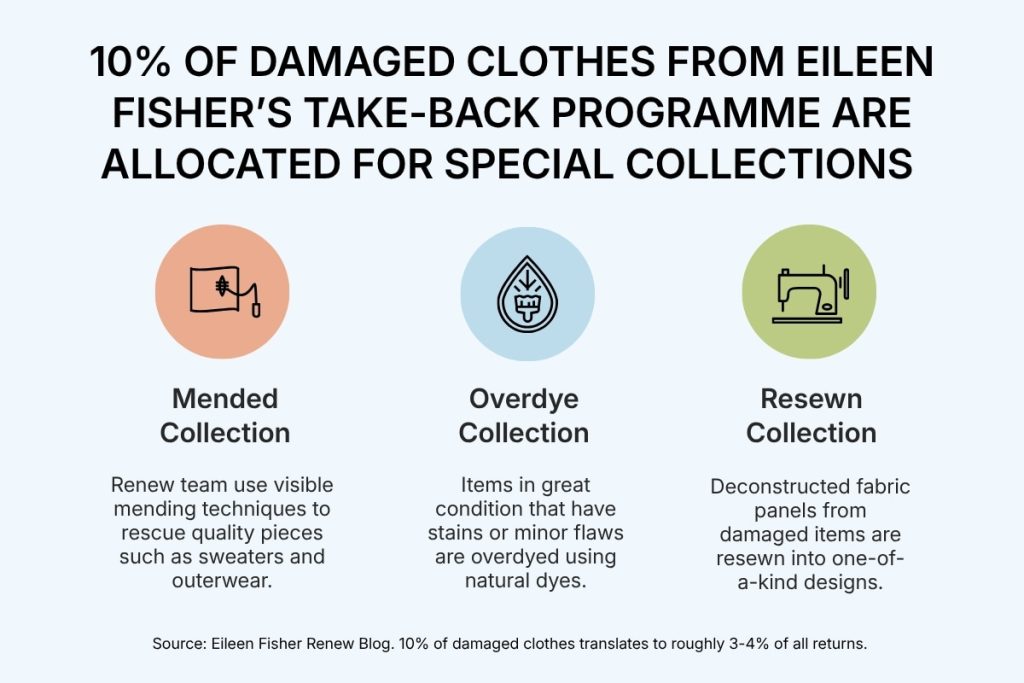
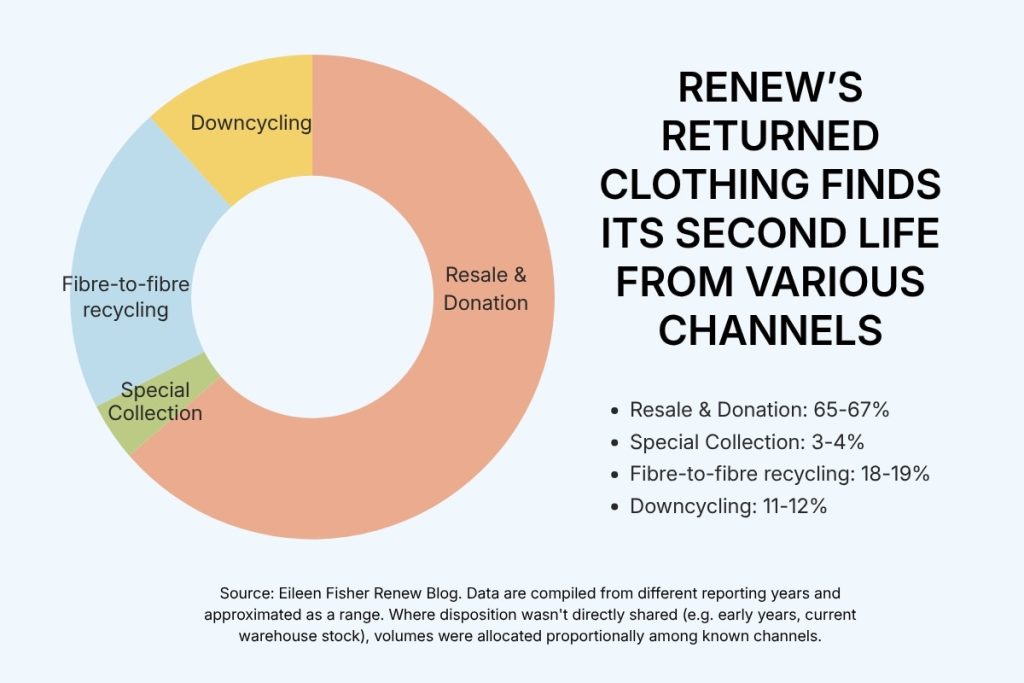
“There’s no one big, overarching solution. The trick is to trust that many small initiatives, pursued separately or knit together, can add up to a huge positive impact,” says Carmen Gama, Eileen Fisher’s Director of Circularity. More than a decade in, even as fibre-to-fibre recycling scales, the Renew team still repair, redye, or resew 10% of damaged clothing in-house and sells the pieces as Special Collections.
Recycling itself happens through multiple experiments. The brand partners with recycling mills in Italy, Spain, Guatemala, constantly looking for new ways to turn damaged garments into fresh yarn.
From art installations to a dedicated design studio making artisanal textile products from preloved clothing and offcuts, Eileen Fisher has always treated circularity as an ongoing experiment. Even after all these years, the brand is honest that much like everyone else, it is still on the path of becoming circular.
4. It is a labour of love
If a brand wanted straight, easy profit from take-back, it could run a basic resale model, keeping only what is sellable and discarding the rest. But that is only part of circularity. Eileen Fisher chooses to reinvest the returns from resale into hand-mending, material R&D, and high-value remanufacturing. The purpose is to prove what circular fashion can be. And for that, the fashion industry has the Eileen Fisher team to thank.
Speaking at Axios House in 2024, CEO Lisa Williams acknowledged that despite bringing net financial benefit, Renew’s revenue is only 2% of the business. “We’re working very hard to scale that,” she said, “but it’s worth it.”
(Images courtesy of Eileen Fisher and Eileen Fisher Renew. Infographics designed by Lucerna Impact.)
On a Circular Fashion Journey Yourself?
Wherever you are in the world, get in touch to share your ideas, progress, or hurdles.
We’d love to hear your story, or put our heads together to solve your current challenges with you.
Keep Reading

The Short, Medium, and Long Loops of Circular Fashion
A clear guide to circular fashion in Singapore, what it means, how it differs from sustainability and ESG, and the three pathways to start the…
8 Hands-On Upcycling Workshop Ideas for Diverse Groups
Explore 8 engaging upcycling ideas community events or corporate sustainability days that show textile waste actions everyone can take.
Sakala-si and Sakiori: How Designers Elevate Upcycled Textiles on the Global Runway
How runway fashion labels upcycle without limiting design freedom: A case study for brands rethinking upcycling and circularity